
The Reality of Restaurant Marketing in the United States
Restaurant digital marketing in the United States operates in one of the most competitive foodservice environments in the world. Consumers have endless choices, strong brand awareness, and high expectations for speed, transparency, and convenience. Most dining decisions are made online—often within minutes—based on search results, reviews, photos, and ease of ordering.
For U.S. restaurants, digital marketing is no longer about promotion. It is about visibility at the moment of intent, credibility across platforms, and frictionless customer experience.
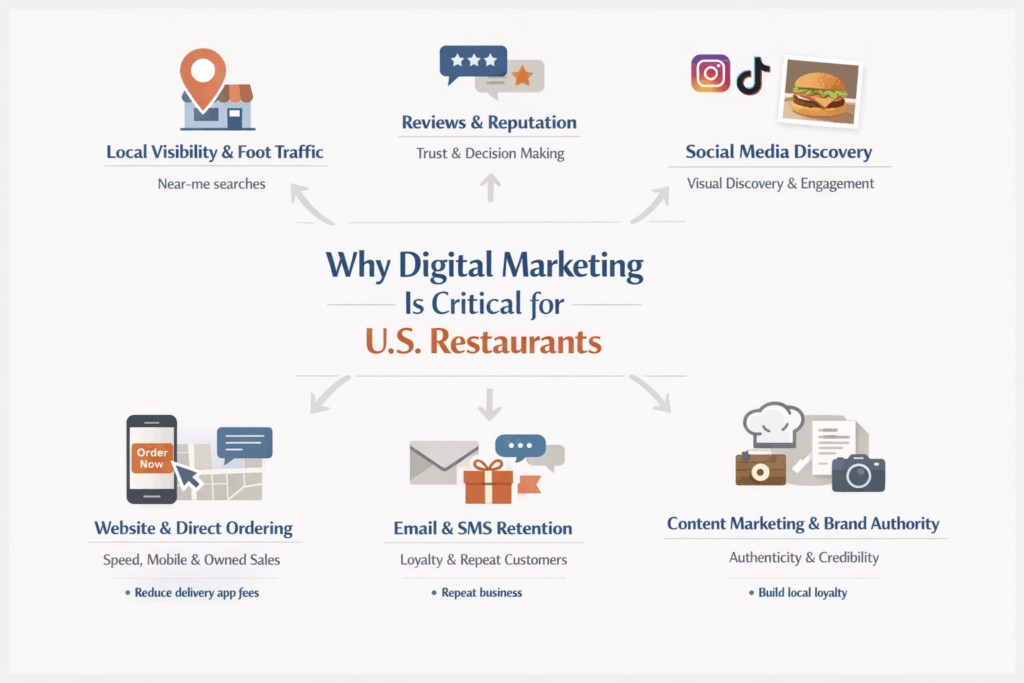
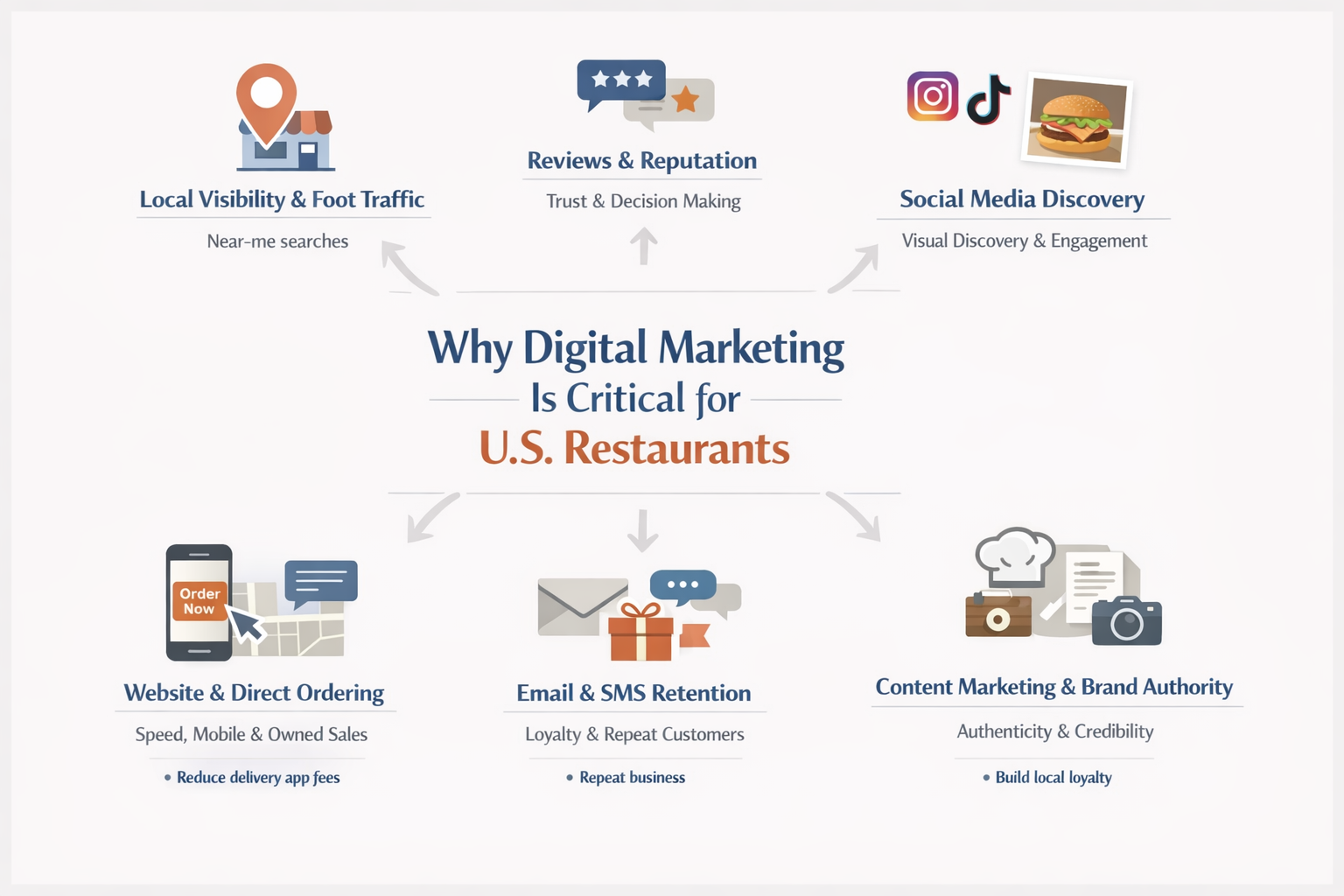
Why Digital Marketing Is Critical for U.S. Restaurants
American diners rely heavily on digital signals before choosing where to eat. Whether searching “best burgers near me” or comparing delivery options during peak hours, customers expect accurate information and social proof immediately.
Strong digital marketing helps U.S. restaurants:
Compete locally against chains and franchises
Capture high-intent “near me” searches
Reduce dependence on third-party delivery apps
Build repeat business in crowded urban markets
In cities and suburbs alike, the restaurants that win are the ones that control their digital footprint.
Local SEO and Google Business Profile in the U.S.
Local search is the single most important acquisition channel for U.S. restaurants. Optimizing Google Business Profile directly impacts foot traffic, calls, and online orders.
In the U.S. market, high-performing restaurant listings focus on:
-
-
-
Accurate categories and service attributes
-
Consistent hours, including holidays
-
High-quality, recent photos
-
Active responses to customer reviews
-
Menu links that reflect real pricing
-
-
Search engines prioritize restaurants that demonstrate trust, activity, and relevance at the local level—especially in competitive metro areas.
Reviews and Reputation Management
Reviews influence American diners more than almost any other factor. Platforms such as Yelp, Google, and delivery apps often determine whether a restaurant is even considered.
Effective reputation management includes:
-
-
-
Encouraging reviews from satisfied customers
-
Responding professionally to negative feedback
-
Identifying recurring issues mentioned in reviews
-
Using feedback to improve operations, not just ratings
-
-
Restaurants that engage consistently with reviews tend to outperform competitors with similar food quality but weaker digital trust signals.
Social Media as a Discovery Channel
In the U.S., social media plays a central role in restaurant discovery, particularly among younger demographics. Platforms like Instagram and TikTok function as visual search engines for food.
Successful American restaurants use social media to show:
-
-
-
Real dishes served to real customers
-
Short-form kitchen and prep content
-
Staff personalities and local culture
-
Limited-time offers tied to trends or seasons
-
-
Authenticity consistently outperforms polished advertising. Content that feels local and human builds stronger engagement and shares.
Website Performance and Direct Online Ordering
U.S. consumers expect speed. A slow or confusing restaurant website directly leads to lost revenue. Mobile-first design is not optional—it is the baseline.
High-converting restaurant websites in the U.S. prioritize:
-
-
-
Clear menus with current prices
-
Prominent order and reservation buttons
-
Fast-loading mobile pages
-
Direct online ordering to avoid high commissions
-
-
Owning the ordering experience allows restaurants to collect customer data, build loyalty programs, and improve long-term margins.
Email and SMS Marketing for Retention
In the United States, email and SMS remain powerful retention tools when used responsibly. Customers are receptive to messages that are timely, relevant, and personal.
Effective restaurant messaging strategies include:
-
-
-
Order-based recommendations
-
Birthday or loyalty rewards
-
Local event promotions
-
Re-engagement offers for inactive customers
-
-
Restaurants that segment their audience by behavior and frequency see higher lifetime value and lower churn.
Content Marketing and Brand Authority
For U.S. restaurants, content marketing is about credibility and differentiation. Sharing stories about sourcing, preparation, sustainability, or local partnerships builds trust beyond advertising.
Examples of effective content include:
-
-
-
Chef insights and menu explanations
-
Behind-the-scenes preparation processes
-
Local supplier spotlights
-
Seasonal menu updates with context
-
-
This type of content supports search visibility while reinforcing brand authenticity—an important E-E-A-T signal.
Measuring Success in the U.S. Market
Digital performance should always connect back to revenue and retention. Vanity metrics do not reflect business health.
Key metrics U.S. restaurants should track:
-
-
-
Local search impressions and clicks
-
Calls, direction requests, and reservations
-
Online order volume and repeat rate
-
Customer acquisition cost by channel
-
Email and SMS conversion rates
-
-
Data-driven adjustments are essential in a market where competition shifts quickly.
Building a Scalable Digital Strategy for U.S. Restaurants
Successful restaurant digital marketing in the U.S. is built on systems, not isolated tactics. Local SEO, social discovery, direct ordering, and retention must work together.
Restaurants that focus on clarity, consistency, and customer value—rather than aggressive promotion—are better positioned to grow sustainably, even in highly competitive regions.
References
-
Google. Creating helpful, reliable, people-first content.
Google Search Central Documentation.
https://developers.google.com/search/docs/fundamentals/creating-helpful-content -
Google. Guidance on AI-generated content and Search.
Google Search Central Blog.
https://developers.google.com/search/blog/2023/02/google-search-ai-content -
Google. Local search ranking factors and Google Business Profile best practices.
https://developers.google.com/search/docs/appearance/local-search -
National Restaurant Association. State of the Restaurant Industry Reports.
https://restaurant.org/research-and-media/research/industry-reports -
Pew Research Center. Social media use in the United States.
https://www.pewresearch.org/internet/ -
Yelp. Consumer trust and local reviews data.
https://www.yelp-press.com/company/fast-facts/ -
Statista. Online food delivery and digital dining behavior in the U.S.
https://www.statista.com/markets/418/topic/484/food-delivery/ -
Think with Google. U.S. consumer search behavior and local intent insights.
https://www.thinkwithgoogle.com/consumer-insights/
By optimizing Google Business Profile, managing reviews, and ensuring accurate local information across platforms.
Yes. Social platforms influence discovery and brand perception, especially among younger and mobile-first audiences.
Delivery apps provide exposure, but long-term growth comes from building direct relationships through owned channels.