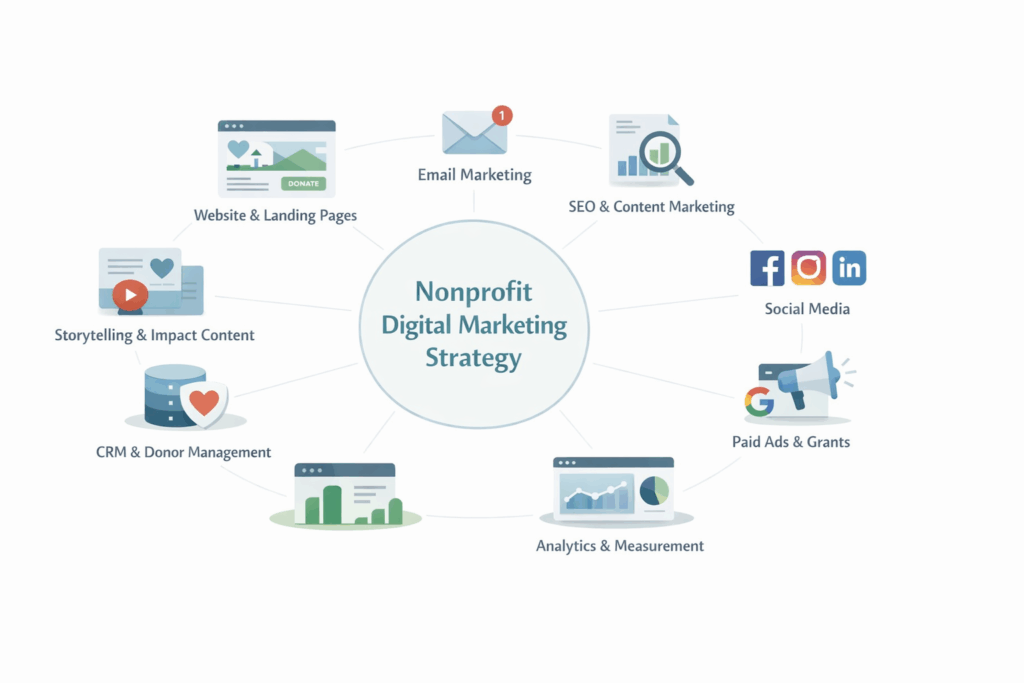

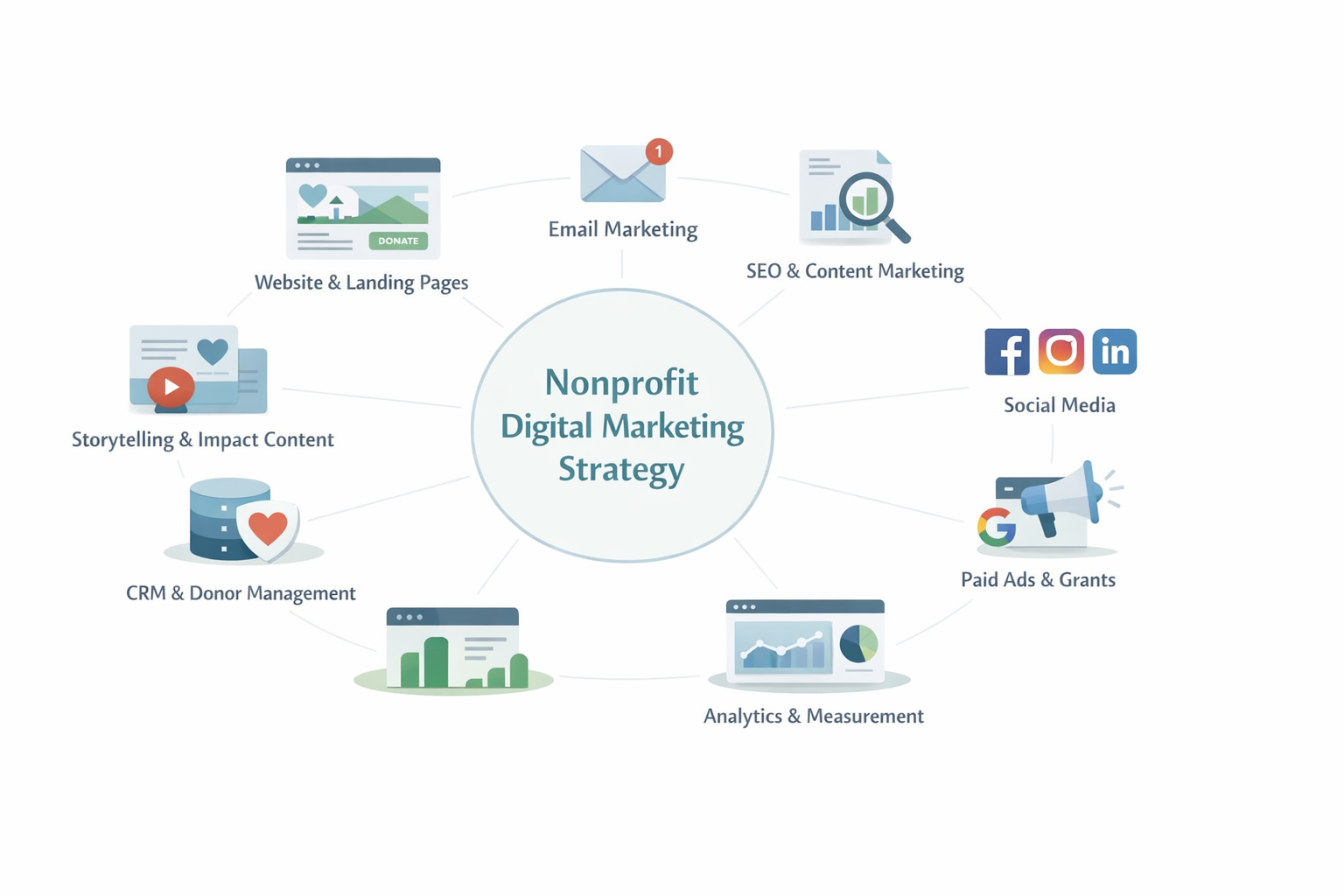
Digital marketing is one of the few levers nonprofits can scale without scaling headcount. Done well, it turns mission clarity into measurable growth: more people discovering your work, more donors converting, and more supporters staying engaged beyond one-time giving.
Done poorly, it becomes a treadmill of posts, emails, and campaigns that feel busy—but don’t reliably build awareness or revenue. The difference is not “more channels.” It’s a system: the right goals, a simple measurement model, and content that earns trust quickly.
This guide walks through a practical nonprofit digital marketing approach that works for small and mid-sized teams, with examples and channel-specific tactics you can implement without turning your org into a full-time marketing shop.
What makes nonprofit digital marketing different
Nonprofit marketing has to win on two dimensions at once:
Emotional resonance: People give and volunteer because they feel something—hope, urgency, belonging, responsibility.
Rational confidence: People follow through when they trust you—clear outcomes, transparent use of funds, credible proof.
For-profit marketing can sometimes “sell the dream” and let the product experience confirm value later. Nonprofits often need trust up front—before someone donates, shares, or lends their name to your cause.
That’s why the core assets matter more than any single tactic:
A website that answers donor questions in minutes, not days
Clear programs and outcomes
Consistent messaging across channels
Measurement that connects attention to action
Start with a mission-to-metrics framework
Define one primary goal per campaign
Most nonprofit campaigns fail because they try to do everything at once: awareness, donations, volunteers, petitions, event signups, and newsletter growth. Pick one primary conversion goal and treat everything else as supportive.
Common primary goals:
Monthly donor signups (high LTV)
One-time donations for a time-bound need
Email list growth (when you’re early-stage or rebuilding)
Event registrations
Volunteer applications
Then define the secondary metrics you’ll accept as progress:
Cost per email subscriber
Donation conversion rate
Landing page conversion rate
Percentage of new donors vs returning donors
Map the supporter journey
A simple donor journey model keeps your content and ads honest:
Discover (they don’t know you): educational content, search visibility, partner mentions
Trust (they’re curious): proof points, transparency pages, impact stories, FAQs
Act (they’re ready): a focused landing page, minimal friction donation flow
Stay (retention): onboarding series, updates tied to outcomes, monthly donor value
If your team is overwhelmed, prioritize “Trust” and “Stay.” Retention work compounds faster than constant top-of-funnel chasing.
Build your owned media foundation first
Website essentials for trust and conversion
Your website is your conversion engine, even when the conversion happens on social or a third-party platform. People still “check you out” before acting.
High-impact nonprofit website elements:
Clear “What we do” and “Who we serve” above the fold on program pages
Specific outcomes, not just activities (numbers, timeframes, scope)
Donation page that feels safe: recognizable payment options, transparent language, minimal steps
Trust signals: annual report, audited financials (when available), board listing, partner logos, press mentions
Fast, mobile-first UX: many donors will arrive from social on phones
A dedicated “How your donation is used” page (linked from donation CTAs)
If you publish content, align it with a people-first standard: the page should answer real questions, cite credible sources, and provide a satisfying experience—not just rank for keywords. Google’s guidance on helpful, reliable, people-first content is a useful quality checklist, especially as search experiences evolve.
Email is still the nonprofit growth engine
If social platforms are rented land, email is owned land. It remains one of the best-performing channels for nonprofits because it compounds: your list grows, your segmentation improves, and retention becomes easier.
Benchmarks vary by source and methodology, but nonprofit email engagement is often strong relative to many industries. Mailchimp’s published benchmarks list nonprofit average open rates and click rates, and Neon One reports nonprofit open rates in the high 20s with click rates around 3%. Use these as directional references, not absolute targets.
Email basics that outperform “newsletter-only” habits:
Welcome series (3–5 emails): mission, credibility, one impact story, a specific ask (donate/volunteer/share)
Monthly donor onboarding: reinforce the identity (“you’re the kind of person who…”), show what their support enables
Segmentation by intent: donors vs non-donors, volunteers, event attendees, major donor prospects
Consistent impact updates: short, outcome-focused, with a human voice and one clear CTA
A practical cadence for a small team:
2 emails per month baseline (impact + action)
1 additional email during campaign windows
Automated flows do the heavy lifting (welcome, post-donation thanks, lapsed donor re-engagement)
SEO for nonprofits
SEO is not “blogging more.” For nonprofits, it’s often about building a small set of highly trusted pages that match how people search for problems, services, and ways to help.
Program pages, resource hubs, and local visibility
High-intent nonprofit SEO targets:
“How to help” pages (donate, volunteer, partner, sponsor)
Service pages for beneficiaries (eligibility, location, application steps)
Resource hubs (guides, templates, explainers)
Local search if you serve a geography (service areas, Google Business Profile where applicable, local partnerships)
A strong nonprofit SEO content model:
One pillar page: “Your mission area + practical guide”
Supporting cluster pages: specific questions, local variations, program details
Internal links from each cluster to the pillar and to the relevant action page
E-E-A-T signals that reduce donor friction
E-E-A-T isn’t a checkbox, but in practice it means your pages make it easy to believe you:
Real authorship and editorial responsibility
Cited sources for claims and statistics
Direct experience (photos, field notes, project updates)
Clear “who we are” and accountability pages
Google’s guidance emphasizes creating content primarily for people and evaluating content quality with practical questions. That mindset aligns well with nonprofit trust-building.
Social media that moves people to act
Social works when you stop treating it as a broadcast channel and start treating it as a sequence: attention → belief → action.
Content pillars and a realistic cadence
Pick 3–5 pillars you can sustain:
Impact evidence (outcomes, before/after, program updates)
Human stories (beneficiaries with consent, volunteers, staff field moments)
Education (what’s changing, what people misunderstand, what helps)
Behind-the-scenes trust (how funds are used, process transparency)
Calls to action (donate, volunteer, advocate, attend)
A realistic weekly cadence for small teams:
3–5 short posts (reels or carousels if you can)
1 longer story/update
1 explicit ask (not every post, but consistently)
Fundraising tools and native donation flows
Reducing friction matters. If a platform offers native donation tools (where eligible), test them against “link in bio” flows. Meta provides fundraising tools and nonprofit onboarding resources; eligibility can vary by country and program rules, so treat platform documentation as your source of truth.
Paid media for nonprofits
Paid media is not a replacement for strategy. It’s an amplifier. If the landing page and message are unclear, paid will only scale confusion.
Google Ad Grants
Google Ad Grants can provide eligible nonprofits with up to $10,000 USD per month in in-kind search advertising. It’s one of the highest-leverage programs available, but it requires structure and ongoing optimization to be effective.
Practical Ad Grants tactics that perform:
Focus on high-intent keywords: donate, volunteer, services, specific program terms
Build tight ad groups and matching landing pages (avoid generic homepage traffic)
Create separate campaigns for:
Donations
Volunteers
Brand protection (your org name + variations)
Program/services (if relevant)
If your team is new to search ads, start with 2–3 campaigns only. Win on clarity before breadth.
Paid social and retargeting (with guardrails)
Paid social is strongest for:
Email lead generation (with a strong lead magnet)
Event registrations
Retargeting site visitors and video viewers
Small-dollar donor acquisition (when creative + landing page are strong)
Guardrails for nonprofits:
Avoid “cold donation asks” without a trust runway
Use retargeting to bring people back to:
A credibility page (impact report)
A specific campaign landing page
A monthly giving page with clear value
Content and storytelling that earns attention
The “evidence + empathy” model
Nonprofit storytelling works best when it combines:
Empathy: one person, one moment, one specific challenge
Evidence: what changed, what your org did, what it cost, what results were achieved
Agency: what the supporter can do next, in one clear action
A strong impact post structure:
One concrete scene
One statistic or measurable outcome (with a source if external)
One sentence of transparency (how support is used)
One CTA
Video and creator partnerships
Short video continues to be a high-reach format, but the production bar does not need to be cinematic. What matters:
Clear audio
One idea per clip
Captions
A direct link between the story and a next step
Partnerships can also outperform your own reach:
Local creators aligned with your cause
Corporate partners with employee communities
Peer-to-peer ambassadors (especially for time-bound campaigns)
Measurement, attribution, and reporting
A minimalist KPI dashboard
If you track everything, you’ll manage nothing. Start with a monthly dashboard:
Awareness
Website sessions (by channel)
Video views and completion rate (if using video)
Engagement
Email list growth
Email click rate (more reliable than opens given privacy changes)
Landing page conversion rate
Revenue / action
Donations (count + value)
Monthly donor adds and churn
Volunteer applications or event registrations
Email benchmarks from providers can help you sense-check performance, but focus on improving your own baseline month over month.
Testing roadmap: what to A/B first
Highest ROI tests:
Donation page headline + proof points
Suggested giving amounts (anchoring matters)
Monthly giving positioning (what does “monthly” fund?)
Email subject lines for campaign windows
Ad landing page alignment (keyword → ad copy → page headline)
Keep tests simple: one variable at a time, run long enough to avoid noise.
Common pitfalls (and how to avoid them)
Posting without a conversion path: every channel should have a logical next step.
Too many asks, not enough proof: balance campaigns with consistent impact updates.
One-size-fits-all messaging: segment email and tailor landing pages.
Chasing trends: prioritize repeatable formats and evergreen search intent.
Weak “why us” clarity: donors need to understand what is uniquely effective about your approach.
30–60–90 day action plan
First 30 days: foundations
Audit website trust pages (impact, financials, leadership, FAQs)
Set up email welcome series and post-donation automation
Define 3 content pillars and build a simple editorial calendar
Create one campaign landing page template
Days 31–60: acquisition
Publish one pillar SEO guide + 3 supporting articles
Launch a small paid test (either Ad Grants or paid social lead gen)
Build a retargeting audience (site visitors, video viewers)
Days 61–90: optimization
Improve donation flow based on analytics
Segment email (donors vs non-donors; engaged vs inactive)
Document learnings and repeat what worked
References
Google Search Central. Creating Helpful, Reliable, People-First Content.
Official guidance outlining how Google evaluates content quality, experience, trust, and usefulness.
https://developers.google.com/search/docs/fundamentals/creating-helpful-contentGoogle Search Central. Content and AI: Guidance for Publishers.
Explains how AI-assisted content is evaluated and the importance of originality, value, and human oversight.
https://developers.google.com/search/docs/fundamentals/ai-generated-contentGoogle for Nonprofits. Google Ad Grants Overview and Eligibility.
Details eligibility, policies, and best practices for nonprofit search advertising.
https://www.google.com/grants/Meta for Nonprofits. Fundraising Tools and Charitable Giving on Facebook and Instagram.
Overview of native donation tools, eligibility, and nonprofit onboarding processes.
https://www.facebook.com/business/nonprofitsMailchimp. Email Marketing Benchmarks by Industry.
Industry-level email performance benchmarks, including nonprofit open and click rates.
https://mailchimp.com/resources/email-marketing-benchmarks/Neon One. Nonprofit Email Marketing Benchmarks Report.
Research-based insights on nonprofit email engagement, donor communication, and retention trends.
https://www.neonone.com/resources/nonprofit-email-marketing-benchmarks/GetResponse. Email Marketing Benchmarks and Trends Report.
Cross-industry data on email performance, automation, and engagement patterns.
https://www.getresponse.com/resources/reports/email-marketing-benchmarksHubSpot. Nonprofit Marketing Guide.
Strategic overview of inbound marketing, content, and digital growth for nonprofit organizations.
https://blog.hubspot.com/marketing/nonprofit-marketingCharity Navigator. How Donors Evaluate Charities.
Insights into transparency, trust signals, and factors that influence donor decision-making.
https://www.charitynavigator.org/
A useful rule is to budget based on goals, not percentages. Start small, measure ROI, and scale what works. If you have access to in-kind programs like Ad Grants, invest time in optimization and conversion improvements first.
Social can drive discovery, but your website is where trust is verified and conversions are owned. You can use native fundraising tools where eligible, but you still need a credible home base that explains impact and accountability.
Email is typically the most controllable channel for retention because you own the list and can automate personalized journeys. Benchmarks and reports show nonprofits can achieve strong engagement when email is used strategically.
By being more specific. Focus on a narrow set of high-intent search topics, tell real stories from the field, and publish proof points consistently. Trust plus clarity often beats volume.